"every man, conducting himself as a good citizen, and being accountable to God alone for his religious opinions, ought to be protected in worshipping the deity according the dictates of his own conscience"
George Washington, May, 1789, Reply to an Address Sent by the General Committee of the United Baptist Churches in Virginia, "A Documentary History of Religion in America to 1877" p 247, edited by Edwin S. Gaustad, Mark A. Noll, published 2003 Wm. B. Eerdmans Publishing Company)
"all men within our territories are protected in worshipping the Deity according the dictates of their consciences"
George Washington, May 26, 1789, Reply to an Address Sent by the General Assembly of Prebyterian Churches in the United States, "A Documentary History of Religion in America to 1877" p 247, edited by Edwin S. Gaustad, Mark A. Noll, published 2003 Wm. B. Eerdmans Publishing Company)
Similar quotes are here to the Quakers, Catholics, and Jews.
Wherefore, honest men and wise men should be sought for diligently, and good men and wise men ye should observe to uphold; (D&C 98:10)
Wednesday, April 1, 2015
According to the Dictates of their Consciences
Posted by
Richard Alger
at
4/01/2015 03:50:00 PM
0
comments
Labels: freedom of religion
Religious Freedom and LGBT Rights
Tal Kopan at politico.com characterized the 2014 AZ SB 1062 as "a controversial measure allowing businesses to refuse service to gay customers." ("Mitt Romney to Jan Brewer: Veto Arizona bill" Feb 25, 2014)
These are the reasons Governor Jan Brewer gave for vetoing it.
Senate Bill 1062 does not address a specific and present concern related to religious liberty in Arizona. I have not heard of one example in Arizona where a business owner’s religious liberty has been violated.
The bill is broadly worded and could result in unintended and negative consequences.
After weighing all of the arguments, I vetoed Senate Bill 1062 moments ago.
To the supporters of the legislation, I want you to know that I understand that long-held norms about marriage and family are being challenged as never before.
Our society is undergoing many dramatic changes. However, I sincerely believe that Senate Bill 1062 has the potential to create more problems than it purports to solve.
It could divide Arizona in ways we cannot even imagine and no one would ever want.
Religious liberty is a core American and Arizona value, so is non-discrimination.
Going forward, let’s turn the ugliness of the debate over Senate Bill 1062 into a renewed search for greater respect and understanding among ALL Arizonans and Americans. ("SB 1062 – Press Conference", Gov. Jan Brewer, Feb 26, 2014)It seems that the debate about the Indiana law has turned ugly. Like Jan Brewer also said. There are probably more important issues that should demand our attention, such as balancing the federal budget or how will we fund local education in the most efficient and effective way.
It seems that the real reason that the Indiana law is so controversial is that
Now that gay marriage is increasingly popular, this RFRA has become a signals contest in the culture war. Obviously nobody is obligated to engage in any form of discrimination in Indiana, and I would wager that 99.9 percent of Indiana's businesses will not turn away a single person for being gay.-
It doesn't actually matter that the RFRA won't really lead to some sort of new dark ages against the gays because culture simply has no interest in going there. The important thing is that people position themselves properly to be seen as good people by their peers. ("Indiana’s RFRA—and the Response—Is All About the Signaling", Scott Shackford, Mar 30, 2015)Here is another article with a pretty good balance in it.
From a libertarian perspective, there’s an easy enough way to resolve the current conflict between demands for religious freedom and equality. It doesn’t fully satisfy either side but it has the virtue of preserving a pluralistic society and minimizing intervention into everyday life.-
Nobody should be forced to do something they don’t want to do, whether it’s bake cakes for gay weddings or decorate cakes with anti-gay slurs. To me, whether a person’s or a business’s decision is based in religion is immaterial. ( "Everybody's Lost Their...", Nick Gillespie, Apr 1, 2015, thedailybeast.com)This is my favorite
Both sides are partly right. And they are both annoying and self-aggrandizing in their righteousness. Given the paucity of actual cases in play—virtually all news accounts recycle a handful of incidents in a few states—it’s clear that the main function of the current controversy is to make religious conservatives feel even more persecuted than usual and to make secular liberals feel as if they are making a last stand for human decency. As my Reason colleague Scott Shackford puts it, “Indiana’s RFRA—and the response—is all about the signaling.”( "Everybody's Lost Their...", Nick Gillespie, Apr 1, 2015, thedailybeast.com)
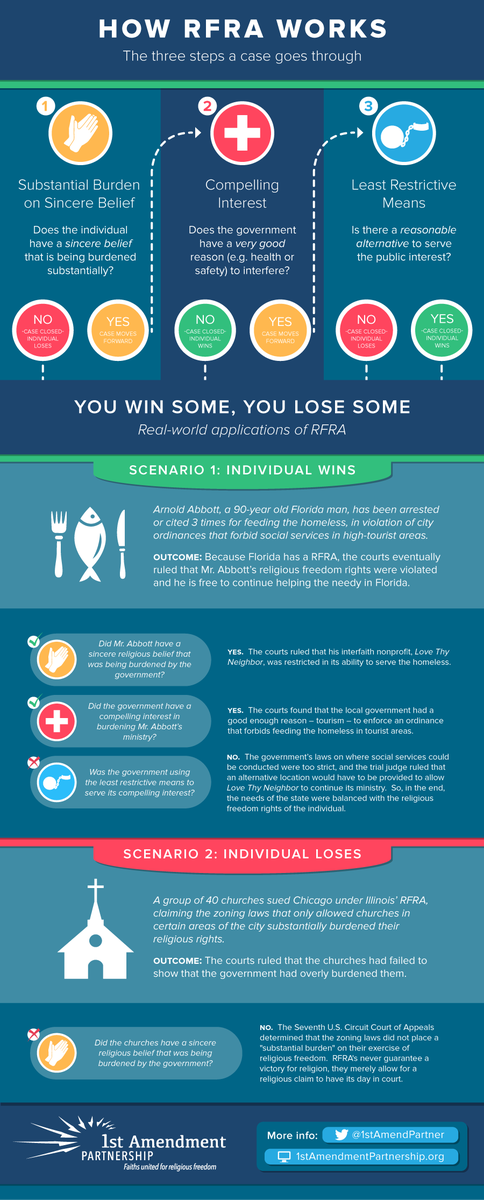
Here is an info-graphic that explains the process of the Religious Freedom Restoration Acts (RFRA)
I do think that balancing the right not to be wrongfully discriminated against with religious rights is an important goal. I like the recent explanation by the LDS church and their recent success in passing legislation that meets at least some of the goals of both sides.
We need to figure out how to act like sisters and brothers with each other. We need to figure out how not to be on sides. But to be on both sides.
Someone is on your side
Jack, LRRH:
OUR side
Baker, Cinderella:
Our side--
Someone else is not
While we're seeing our side
Jack, LRRH:
Our side..
Baker, Cinderella:
Our side--
All:
Maybe we forgot: they are not alone.
No one is alone.
Cinderella:
Hard to see the light now.
Baker:
Just don't let it go
Both:
Things will come out right now.
We can make it so.
Someone is on your side
No one is alone.
(lyrics)
Those who deny freedom to others, deserve it not for themselves; and, under a just God, can not long retain it.
--Abraham Lincoln, April 6, 1859 Letter to Henry Pierce et al
Here is a ridiculously long FB thread endlessly debating the Indiana Law. There are some kernels of value there.
Some examples of the erosion of Religious Liberty
"If there are instances of religious schools being denied accreditation because of the religion"
Trinity Western University of Canada was initially denied accreditation.
Clayton Ruby said, "It is just wrong to have a law school approve discrimination in its own structure. That kind of discrimination, which denies some people the right to equality, is fundamentally inconsistent with law and democracy. This alone makes it incompetent to deliver legal education in the public interest."
http://www.christiantoday.com/article/canadian.provinces.block.accreditation.of.christian.law.school.over.homosexuality.views/37222.htm
It, thankfully has been overturned by the courts
http://www.firstthings.com/blogs/firstthoughts/2015/01/a-victory-for-religious-freedom-in-canada
Another example is that "Judges in California can no longer be members of the Boy Scouts of America because of the organization’s stance on gay leaders."
http://www.mormonnewsroom.org/article/explaining-religious-freedom-and-lgbt-rights
Here is the reasoning the LDS church gave for filing an amicus brief in the Obergefell v. Hodges case coming before the Supreme Court.
How has the meaning of marriage eroded?
Contraception has increased the disconnect between sex and conception. We now only have children if we want them and it is separate from the joy and pleasure of sex. Contraception has given us new power. It can be used by a wife and husband to carefully consider how many and when to have children. Marriage used to be an agreement to create and raise a new generation. It is less so because of birth control.
No-Fault divorce has increased the amount of divorces. There are many cases where divorce is necessary. I would always want there to be an escape from dangerous marriages. It has been abused by many, though, to sever the marriage because they are no longer in love or are fulfilled.
Gay marriage is another contributor to this erosion of the meaning of conjugal marriage.
Posted by
Richard Alger
at
4/01/2015 02:41:00 AM
0
comments
Labels: freedom of religion, LGBT
Tuesday, March 31, 2015
Write Your Elected Officials
Here is a link for Arizona that allows you to easily find out who your state and federal elected officials are.
Use it or something similar in your state. Be involved.
Posted by
Richard Alger
at
3/31/2015 10:08:00 AM
0
comments
Labels: civically active
Saturday, March 28, 2015
Capitalism and Consecration
First off I state the short conclusion of Geoff B in another post "capitalism is the least worst system available to us — until Zion can be achieved"
If Zion is what we are working towards what is it? How might we define it in terms all people might be able to agree on? I think you might say that Zion or utopia is where every one is free to do as they will and are able. Those that are more able are willing to help those that are less able to assist them in becoming more able. Those that are less able are willing to accept help and responsibility to become self-sufficient and then pay it forward.
In order to freely give you must first truly own.
one needs to actually have property (or a substantial amount of property) as well as freedom to be ABLE to live consecration. The morality of libertarianism is freedom and the right to reap what you sow. The morality of consecration is to freely give of your reaping to others and have that be a blessing to the giver and the receiver. You can’t really have one without the other, in my view, which is why I think that individualism plays a big part in the gospel. Libertarianism doesn’t tell you what you are supposed to do with your property, or that you can’t be a collectivist. But it does give more freedom and means to actually be a collectivist if you so wish it. Could we not substitute individualism in a political sense for agency in a gospel sense and find a similar set of values? (Pierce)
It is not really up to only ourselves to decide who to help and how
If we are honest with ourselves, we recognize that at times, we are selfish. Regardless if you believe in a Supreme Being, we all are alive now because of the willing gift of someone else. Someone to care for us as infants and children. We should look to a Greater Good when trying to discern how to best lift others and to be lifted ourselves.I think a lot of those member think that it is up to them as individuals how and to whom they are to redistribute wealth and property, whereas the law of consecration tells us that it is up to the Lord and His church to do this. These are two very different moralities and right-wing members too often confuse the two. (Jeff G)-
How many Mormons are willing, right now, to scale down their living style and actually give the excess to other poor LDS families to the point that the other families would be on a similar socio-economic footing as them?
Probably none. (Pierce)
The Lord intends the poor to be exalted and the rich to be made low
15 ...it is my purpose to provide for my saints, for all things are mine.
16 But it must needs be done in mine own way; and behold this is the way that I, the Lord, have decreed to provide for my saints, that the poor shall be exalted, in that the rich are made low.
17 For the earth is full, and there is enough and to spare; yea, I prepared all things, and have given unto the children of men to be agents unto themselves. (D&C 104:15-17)
Giving is better than Coercion
fundamental to democracy, and fundamental to capitalism is a religious sense, is a religious life. And out of that grew this idea that what we have to enforce the unenforceable. You have to voluntarily choose to be honest. You have to voluntarily honor a contract. You have to voluntarily care about what the course of your community is, or the integrity of your leaders. We can’t hire enough policemen to do that. You can’t get a government oppressive enough or large enough to manage all of that. That has to be something from the human heart. That has to be something from the soul. And that’s what a morally honest and a religiously oriented people do for democracy. ("A Conversation with LDS Elder Jeffrey Holland", Jeffrey R. Holland, Feb 2015)
What do we do with those who do not want to give?
We do, in fact, live in a modern society. We do have a responsibility to take care of the poor and disadvantaged, and the combined charities (including all churches) do not have the wherewithal to do so. This is one reason why we have governments.
It is, therefore, not confiscation (I think that’s the word you were after, not compensation) when the government taxes us in order to create some sort of minimum level of suffering in society as well as provide all the things we think government ought to do (streets, libraries, police, etc.) It is simply the price of living in a modern society.
The hyperidealistic delusion of libertarians that we still live in the wild west where rugged individualism reigns and everybody is able to make it on his or her own is a utopia that never existed and never will.
Consider please that even the city of Enoch had a government and required certain things of its citizens. (Lew Scannon)It seems that we have one of two choices or somewhere in between.
One, we could kick out anyone who is not willing to freely give what has been gifted to them from God. I imagine that this is what the Celestial Kingdom is. Only those that are full willing to give all that they have can be in such a perfect society.
Or two, We could compel those in the society to give.
It seems to me that the first option is preferable, this gets to the crux of "capitalism is the least worst system available to us — until Zion can be achieved".
Consecration is based on voluntary giving and then receiving private property by mutual consent
Jeff, my understanding of the United Order is a bit different; so please let me know if I’m wrong. But as I understand it:
1. The United Order *did* entail private property–you deeded your property to the Church on entry but then had a stewardship–often the same land/house you’d consecrated–deeded right back to you.
2. Periodic contributions of “surplus” to one’s ecclesiastical leader were not based on an assessment from a bishop who arbitrarily decreed that one “had enough”; but by mutual consent between the member and the bishop. The ability to improve your lot in life over last year provided continuing incentive for work even after one’s own basic needs were met–an incentive that altruism alone doesn’t have a great track record of providing.
3. If you look up the D&C passages regarding “idlers”, they are actually quite harsh. I don’t know that the United Order would have completely cut such people loose and leave them to their own devices for sustenance, as many libertarians seem willing to do; but I think that (with the possible exception of medical care) they’d be afforded a standard of living somewhat below what can be had through American government assistance programs (and far below what can be had through similar programs in western Europe).
There are most likely conservatives who use libertarian theory as a crutch to justify personal stinginess (as King Benjamin himself noted); but I don’t think conservativism/libertarianism is uniquely uncharitable. Both sides essentially provide a theoretical “other” who should do my alms for me–“the taxpayers” (a group that, statistically, has a 53% chance of *not* including me) in the case of the left, and “private charities” (a group that includes me only if I want it to) in the case of the right. (JimD)
Capitalism (and Collectivism) is concerned with how to acquire goods and services not what to do with them
I think a relevant question is how to acquire goods. The gospel doesn’t tell us how to acquire goods in an economic sense–only what to do with them once we have them. Capitalism, on the other hand, teaches how best to acquire goods, but not how to use them. So I don’t think one can merely separate the two and say that adopting capitalist doctrine doesn’t follow the gospel, since the gospel doesn’t deal with acquiring goods, and capitalism doesn’t tell you what to do with the goods. The gospel merely picks up at the point of “once you have goods, you need to impart it to the poor and live for the good of the group.”
There’s no doubt that most members are selfish (how many of us live on what we need and donate the rest?) and that can be reflected in our politics (how can we get more for ourselves?), but that really has more to do with acquirED goods rather than acquirING goods. I still think individualism plays a crucial role in gospel/church instituted collectivism.
Especially with libertarianism, the mantra regarding collectivism is: individuals can do it better than a corrupt and inefficient bureaucracy. So the more we retain (from the government, not necessarily for ourselves), the better it will be for everyone. (Pierce)
What might be some good guidelines for a modern implementation of consecration?
- Entering into the Order is voluntary- Once a year, you consecrate all your possessions to the church. Then you and the bishop council together to see what is best to deed back to you. I see the consecration as an act of faith. That the counseling together the bishop, acting as the Lord's representative, is in the driver's seat. If there is no mutual consent, I imagine that you may just leave with what you came in with, but that would certainly bring a lot of consequences. Such as being kicked out of the order. And peer pressure from family and friends.
- You may leave the order at any time. In fact in fact you are really only formally a part of the order when you give a donation.
This arrangement seems to require someone with a Zion-heart and a critical mass of these kinds of people to start and sustain the order. This is why I have so often fallen back to "capitalism is the least worst system available to us — until Zion can be achieved"
Posted by
Richard Alger
at
3/28/2015 06:36:00 AM
1 comments
Labels: capitalism, capitalism tempered by consecration, consecration
Sunday, March 15, 2015
Why Power Companies Want to Discourage Customers Generating Electricity
"If SRP is buying the excess for 10 cents/kwh, and selling it to the neighbor for 10/kwh, there is no profit. It's a wash." ("Critics question SRP's solar-energy payments", Ryan Randazzo, AzCentral.com, Mar 15, 2015)
Posted by
Richard Alger
at
3/15/2015 07:56:00 AM
0
comments
Labels: electricity, solar